‘Bleed’ by The Kid LAROI (2023) : Chorus Chord Progression Tutorial
My attempt at responding to punk, informal learning, and Culturally Responsive pedagogies all in one go.

Hi, I’m Lola (or Ms H if you happen to be a student coming across this). I am currently in the first year of my Master of Teaching (Secondary) at The University of Sydney. The following is my submission for EDMT5702-Music Curriculum 2, Semester 2 2024: Contemporary Developments ePortfolio.
My attempt at responding to punk, informal learning, and Culturally Responsive pedagogies all in one go.
Culturally Responsive Pedagogy – using First Nations music as a white teacher
Pros and Cons of ‘Bleed’ by The Kid LAROI
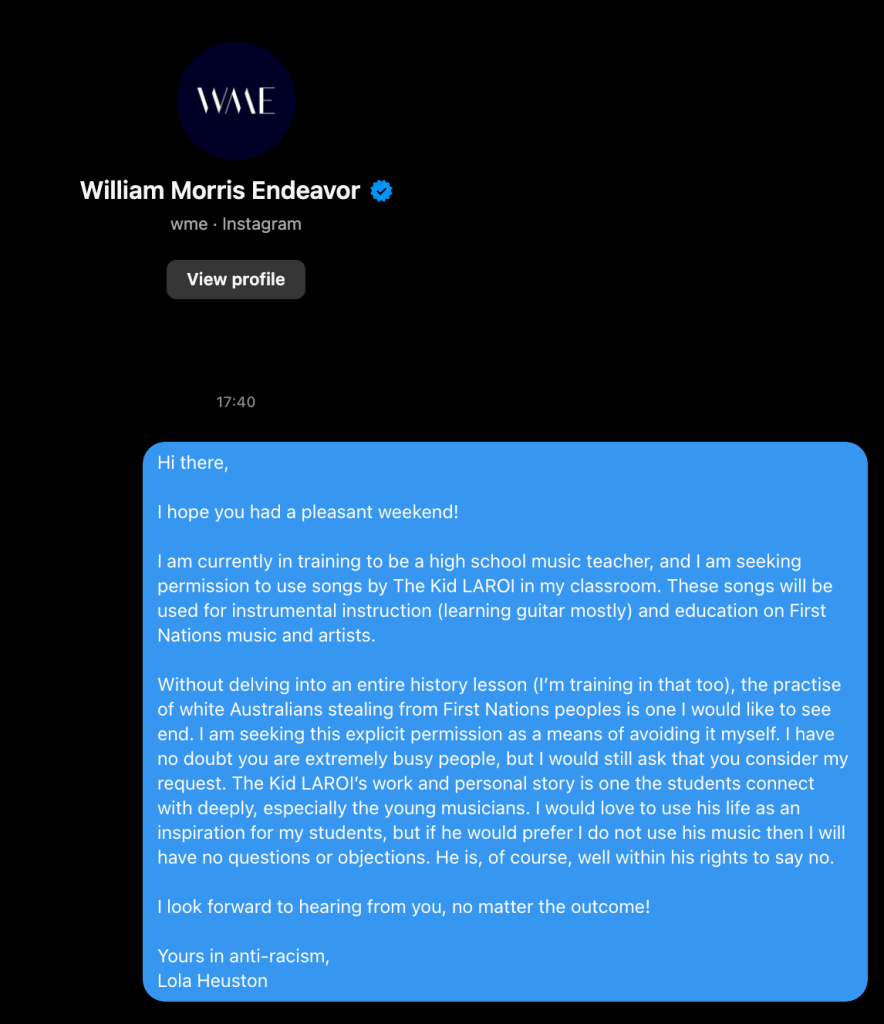
I couldn’t locate an email for his management (WME Australia) so I messaged them on Instagram. I will post any replies as well.
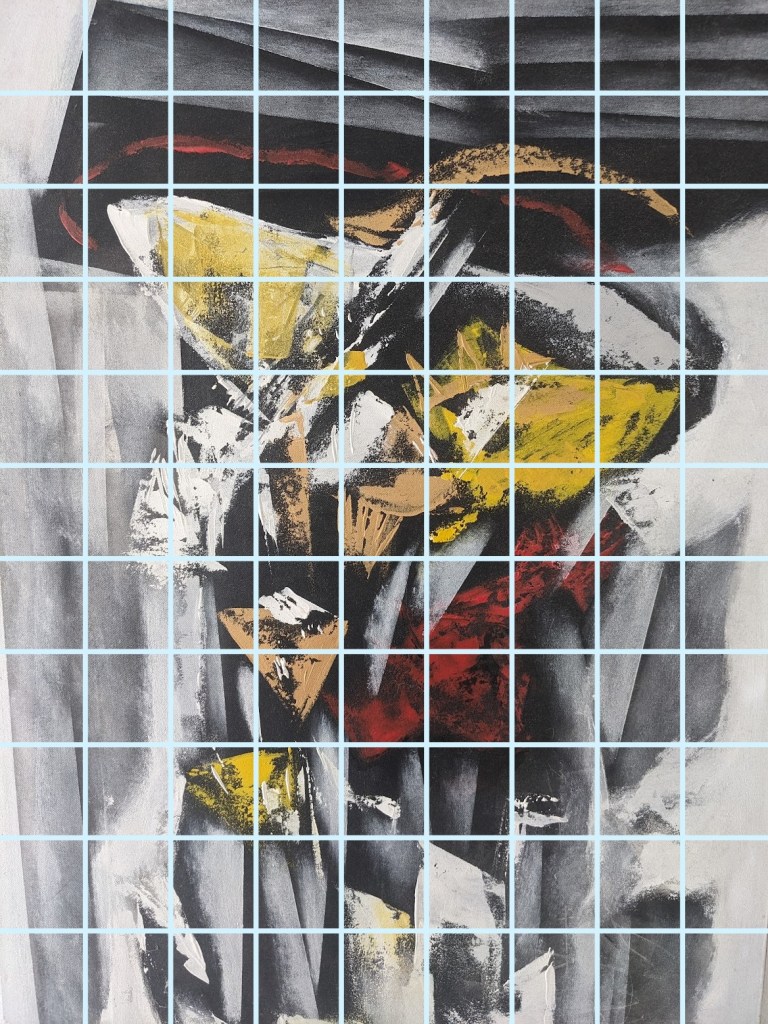
Garage sale abstract no. 2
Painting by Unknown Artist
Composition by Lola Heuston
| Colour | Solfege (Interval) | Tempo |
| White | Do (I) | Slow |
| Red | Re (ii) | Reasonably fast |
| Dark Grey | Mi (iii) | Moderate |
| Yellow | Fa (IV) | Getting pretty fast |
| Black | So (V) | Dead slow |
| Light Grey | La (vi) | Your heartbeat |
| Gold | Ti (vii) | Stupid fast |
Instructions:
Composition for three players – high, middle and low pitches (no words singers!)
The key is harmonic major.
Players to choose which box they will start on and chart a path across the score. Players do not have to play every square on the score.
Players will decide rhythm, dynamics and shape of composition.
Tempo changes are open to interpretation, but pitch must be respected.
Reflection:
In response to our exploration of indeterminate music in class and follow up conversations with other musicians, I wanted to explore the relationship between pitch and colour in an indeterminate composition. My interest was peaked when I realised there were multiple people in my life who have ‘synesthesia’, or the ability to have multiple sensory experiences when only one sense is receiving the required input. Garage sale abstract no. 2 is my take on what is the common form of synesthesia in my life- people see colours when certain pitches are played.
The choice to use this particular painting was a deliberate one. A person with synesthesia (let’s call them my muse, why not?) noted that at a glance, the whirling patterns almost reflect the pattern made by certain melodies and chord progressions (this painting hangs in my hallway, that’s why they told me). What was not consistent with their experience however, was the presence of multiple colours. My muse tends to visualise changing colours when they hear music, rather than all the colours of the individual pitches in a composition at once. That being said, when a singular pitch is played for them, they do experience a colour (the clarity of which is reflective of its tuning). It was for this reason that, once I realised I could utilise a major scale quite neatly with this painting, I decided to give each colour its own interval rather than each shape its own pitch. It would be interesting to see how the interpretation of this score by performers who may or may not have synestheisa manifests itself visually with my muse. I do not expect the colours will match, but I am curious if they will have a more detailed experience of the decided shape of the music.
Once I had decided to experiment with pitch the question became, how much more should the composer be dictating? The answer was, not much. The music won’t be indeterminate if I know what is about to happen, so I offer some guidance on how tempo may reflect the intensity of the colour and I left it at that. I made sure that this score was accessible to as many musicians as possible (I can see a rock band having fun with this? no?) by keeping the instructions in standard English and including solfege/intervals. Now I just need to get a couple of mates to help me play it for my muse and see what colours they experience!
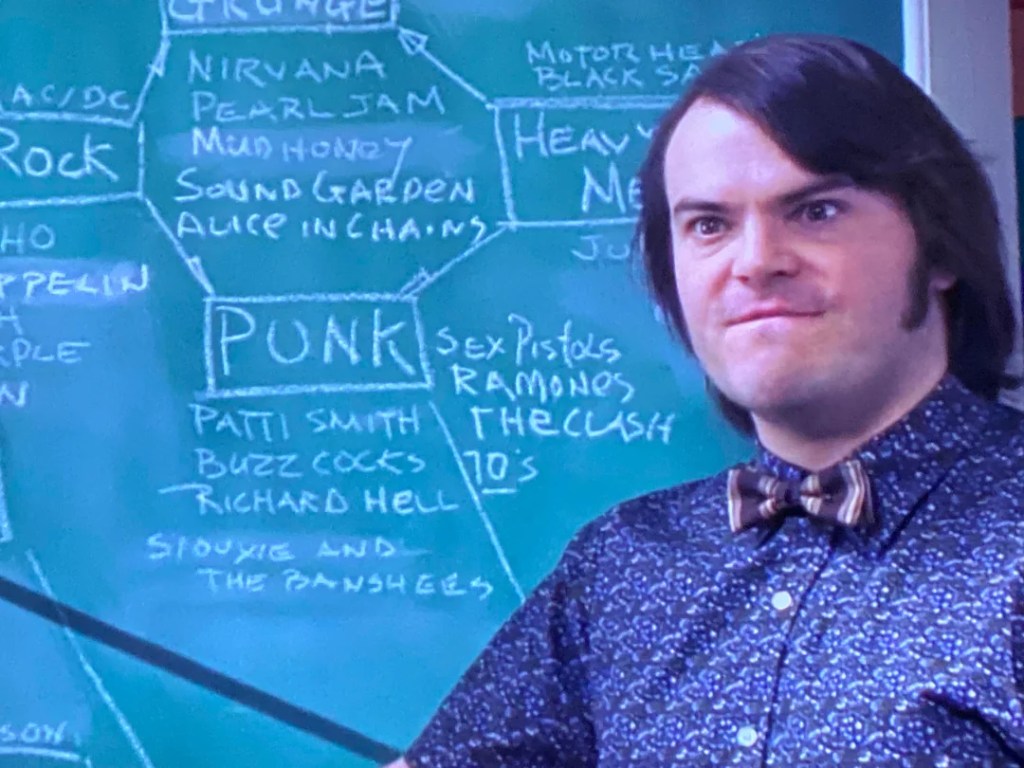
With Lachlan Dibley, Lucy Lush and Sam Zhan
Kahn-Egan, S. (1998). Pedagogy of the Pissed: Punk Pedagogy in the First-Year Writing Classroom. College Composition and Communication, 49(1), 99–104. https://doi.org/10.2307/358563

Out of performance, composition and listening, composition is the only one that allows students to demonstrate completely original creativity in their submission. Its removal from HSC assessments by nature prevents students from being able to demonstrate their creative skills to their fullest extent, should this be their area of speciality.
Furthermore, a 2 hour theory exam is not an appropriate means by which to examine the understanding and skills of musicians working in the popular domain. Students emulate the musicians they admire and will hone skills of their interest, which may have nothing to do with the Western notation system (for instance) the course dictates. In the senior year especially, students should be able to demonstrate their individual knowledge and skills, without being hampered by having to focus on aspects of the art form which are not relevant to their own creative endeavours. We do not ask ballet students to complete an exam in hip-hop, do we?

By way of explaining my disagreement with the repertoire requirements question, my issue is not entirely with the guidance provided. There is only one segment which I find confusing with regard to the wording, as highlighted below.
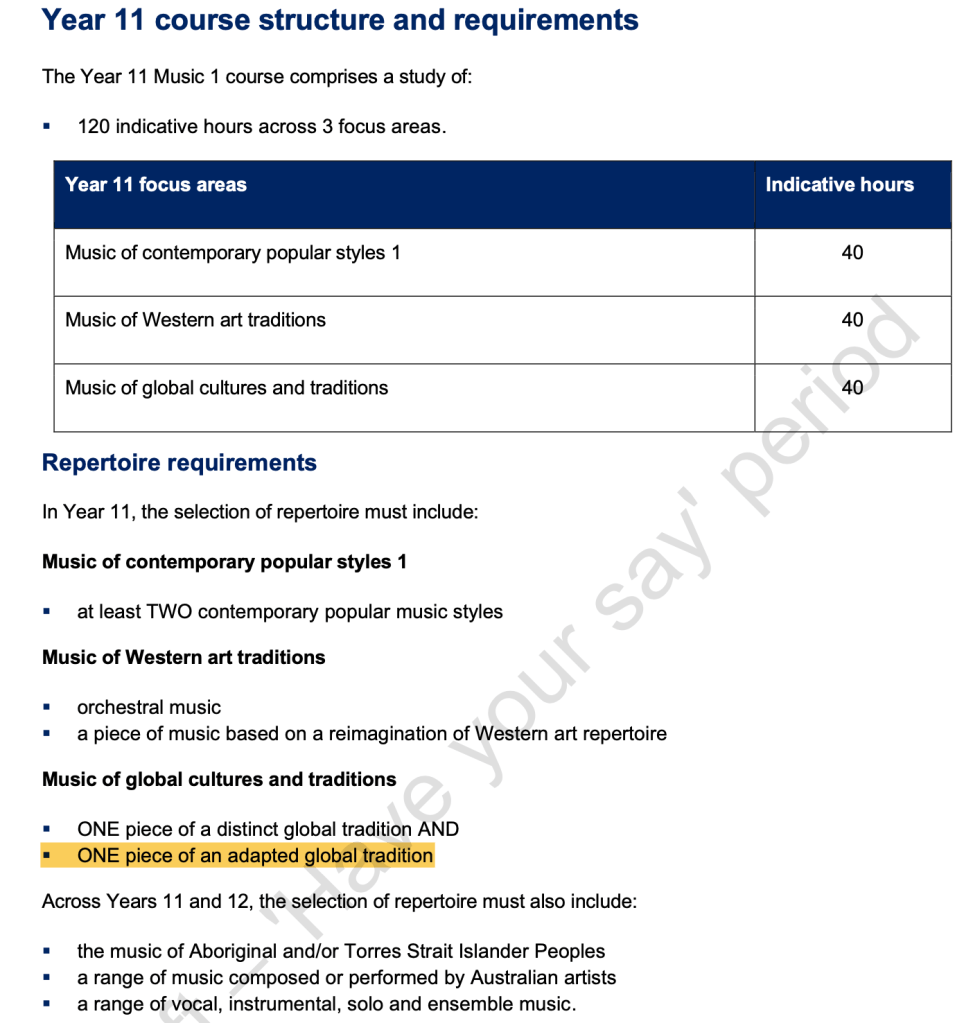
Clarification is needed as to what this phrase actually entails- is the idea that it would be a piece from a global tradition that has changed over time (that’s all of them)? Using traditional techniques in non-traditional music? Exactly what has been adapted?
HOWEVER, there are major issues with the repertoire requirements themselves.
The vast majority of musicians have a specific area they work in which may not include Western Art music… So why are we making our students spend so much time on it? What are we saying to these students about what we value in music in Australia? I have no issue with the inclusion of music from global cultures in the Year 11 syllabus, however there is simply no need for WAM to be mandatory in the senior years. The syllabus would better serve both students and teachers if this focus area was chosen by the teachers based on their classes (with WAM as an option). If a third focus area must be assigned, Australian students would be better served by an in depth study of First Nation’s Music (Then and Now) even if it did mean a considerable amount of new resources being released by NESA.

With Lachlan Dibley, Lucy Lush and Sam Zhan
Dwyer, R. (2015). Unpacking the habitus: Exploring a music teacher’s values, beliefs and practices. Research Studies in Music Education, 37(1), 93–106. https://doi.org/10.1177/1321103×15589260

 Lolagogy